12th–14th c.
Southern France, twelfth century. A countess sings, in her own language, that she wants him. In Florence, Dante begins a book because the girl he loved has died.
Who gets to desire?
A chantar m'er de so qu'ieu no volria.
Comtessa de Dia, “A chantar”
In that book which is my memory, on the first page that is the chapter of my life which has the heading Incipit vita nova.
Dante, Vita Nova
From the Paraclete. A letter.
To her master, nay father,to her husband, nay brother;from his handmaid, nay daughter,his spouse, nay sister:to Abelard, from Heloise.
And if the name of wife appears more sacred and more valid, sweeter to me is ever the word friend, or, if you be not ashamed, concubine or whore.
I preferred love to wedlock, freedom to a bond.
Heloise to Abelard
She has read his letter of consolation to a friend. He was castrated. She is a nun. He will answer as an abbot, not as a lover. The letters as we have them. Authenticity of the corpus is debated.
Heloise.To Abelard.Friend sweeter than wife. He answers as an abbot.
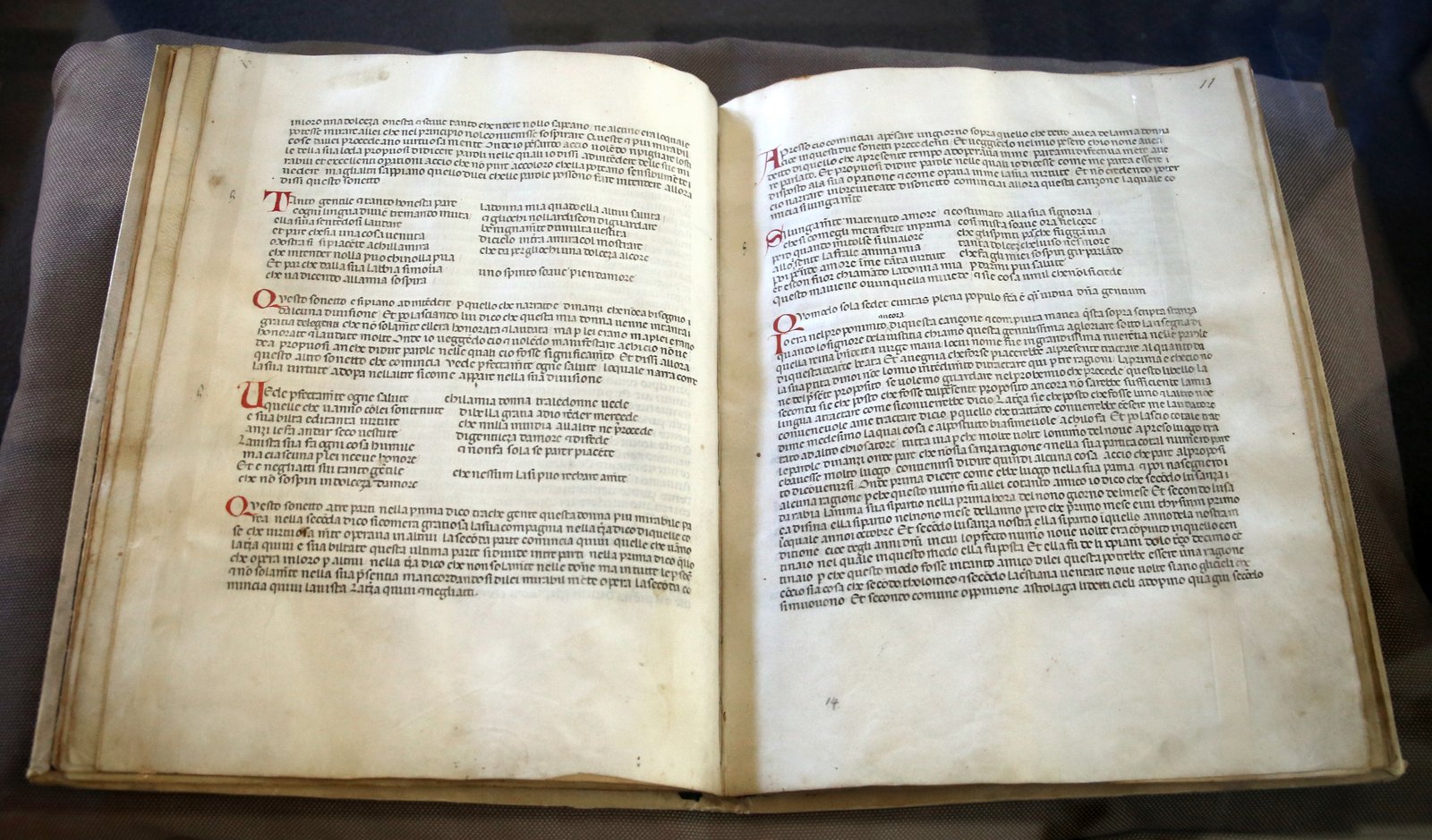
The Comtessa de Dia, a noblewoman in southern France, sings in her own language, Occitan. The line means: I must sing of what I would rather not. She wants the man. Dante, in Florence, loved a girl named Beatrice. She died young. The book in the picture starts in the book of his memory, at the chapter headed: here begins the new life. The name courtly love was invented later, in 1883.
A vernacular code of refined love. Continuity with older lyric, plus a new European fashion. Households still held care the songs omit.
A woman who desires.To the beloved. To the dead.From a convent, to a man who answered as an abbot.
Sources
- Comtessa de Dia. “A chantar m’er de so qu’ieu no volria.” Occitan as transmitted. The line on the page is the canso, not an English rendering.
- Dante Alighieri. Vita Nova. English after Dante Gabriel Rossetti, The Early Italian Poets (London: Smith, Elder, 1861). Public domain.
- Dante, Vita Nova, about 1350. Biblioteca Nazionale Centrale di Firenze, Magliabechiano VI.143.
- Heloise to Abelard, first letter. English after C. K. Scott-Moncrieff, The Letters of Abelard and Heloise (New York: Alfred A. Knopf, 1925). Public domain in the United States. The letters as we have them. Authenticity of the corpus is debated.
.jpg)