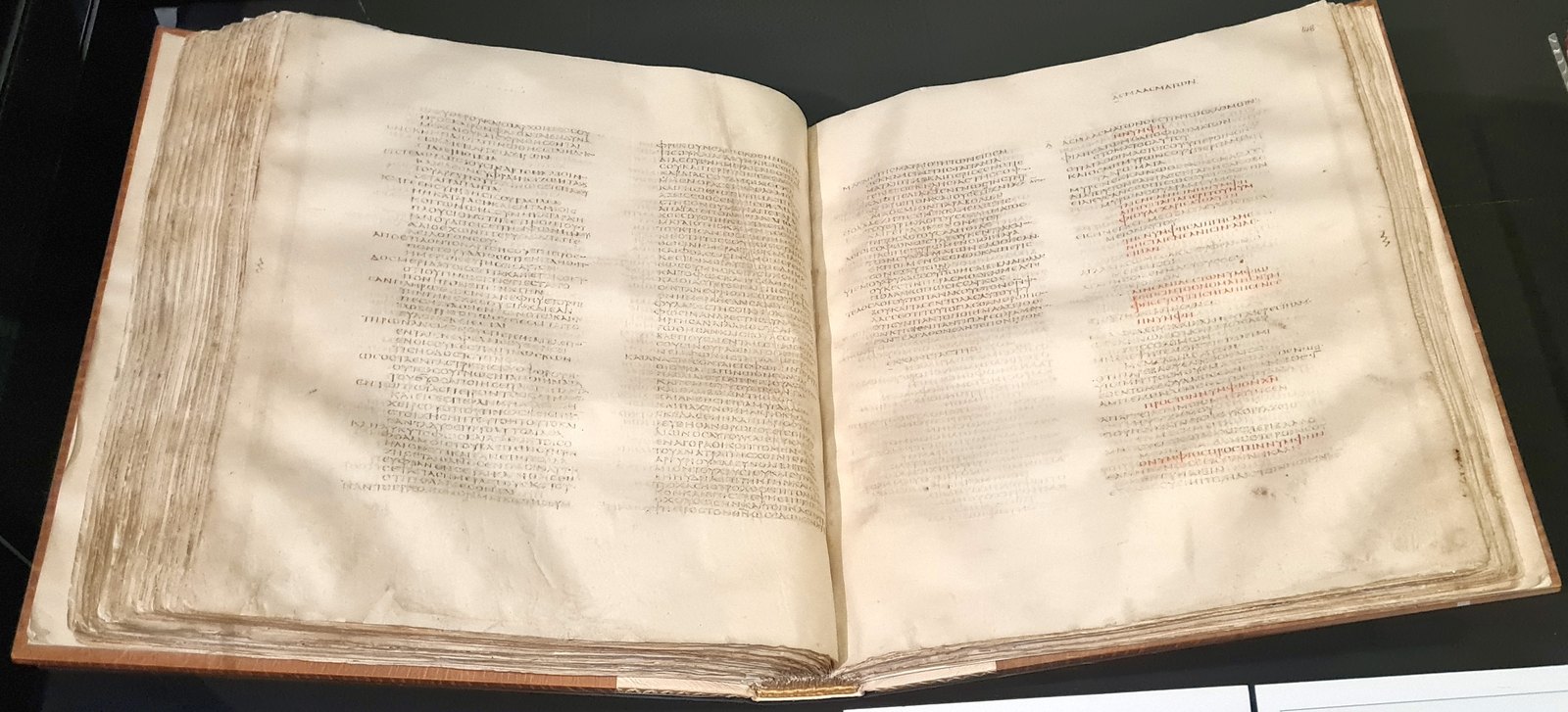
4th c.
A Hebrew song of two lovers. Some readers heard God in it. Later, and not the same night: Rābiʿa in Basra, Mīrābāī singing to Krishna in Rajasthan, Rūmī teaching in Konya.
Can you love without reward?
Set me as a seal upon thine heart, as a seal upon thine arm: for love is strong as death.
Song of Songs 8:6
Basra. Eighth century.
If I worship Thee from fear of Hell, burn me in Hell; if I worship Thee in hope of Paradise, exclude me thence; but if I worship Thee for Thine own sake, withhold not from me Thine eternal Beauty.
Attributed to Rābiʿa of Basra
Rajasthan. Sixteenth century.
गिरधर गोपाल
I know only Krishna. No other.
Mīrābāī, after the Hindi pada
Konya. Thirteenth century.
Love is the astrolabe of the mysteries of God.
Rūmī, Mathnawī I
The seal is from the Song of Songs, a Hebrew poem of two lovers. Love, it says, is as strong as death. Some later readers heard God as the beloved. The photograph is a fourth-century Greek Bible, not that Hebrew scroll. Rābiʿa, in Basra, will not worship in order to gain heaven or escape hell. Mīrābāī, in Rajasthan, left a court and sang only to Krishna. Rūmī, teaching in Konya, calls love the instrument that reads the mysteries of God.
The last line of the Comedy
l'amor che move il sole e l'altre stelle
The Love which moves the sun and the other stars.
Dante, Paradiso XXXIII
1934. A Jesuit paleontologist, looking forward.
The day will come when, after harnessing the ether, the winds, the tides, gravitation, we shall harness for God the energies of love.
And, on that day, for the second time in the history of the world, man will have discovered fire.
Teilhard de Chardin, “The Evolution of Chastity”
Erotic language turns toward God. Traditions stay distinct. They are not one glow.
Beloved to beloved.Then to God.Traditions stay distinct. They are not one glow.
Sources
- Song of Songs 8:6. The Holy Bible. London: Robert Barker, 1611. Public domain. Hebrew. Older than the skin you see.
- Codex Sinaiticus, fourth century. British Library photograph of the book as object. Public domain. Greek Bible on animal skin. Not a photograph of Song of Songs 8:6.
- Attributed to Rābiʿa of Basra in later Sufi lives, especially ʿAṭṭār. English after Claud Field, Mystics and Saints of Islam (London: Francis Griffiths, 1910). Public domain. No autograph of Rābiʿa survives.
- Mīrābāī. Hindi pada often titled from the opening Mere to Giridhar Gopal. English on the page is a house paraphrase of that famous line, not Bly, Alston, or Hirshfield.
- Jalāl al-Dīn Rūmī. Mathnawī I.110. English after Reynold A. Nicholson, The Mathnawí of Jalálu’ddín Rúmí, vol. 2 (London: Luzac, 1926). Public domain in the United States. Persian, inside Islam.
- Dante Alighieri. Paradiso 33.145. “l’amor che move il sole e l’altre stelle.” English after Henry Wadsworth Longfellow, The Divine Comedy of Dante Alighieri (Boston: Ticknor and Fields, 1867). Public domain.
- Teilhard de Chardin, Pierre. “The Evolution of Chastity” (1934). English after René Hague, Toward the Future (London: William Collins, 1975), 86–87. Short quotation for commentary. The translation remains in copyright.
