6th–4th c. BCE
Greece. On Lesbos, Sappho calls a goddess into an apple grove. At a dinner in Athens, they argue what desire wants. A school of friends says you would not choose to live without them.
What does eros want?
Hither to me from Crete, to this holy temple, where is your pleasant grove of apple-trees.
Sappho, fragment 2. House English of the opening. Not Wharton.
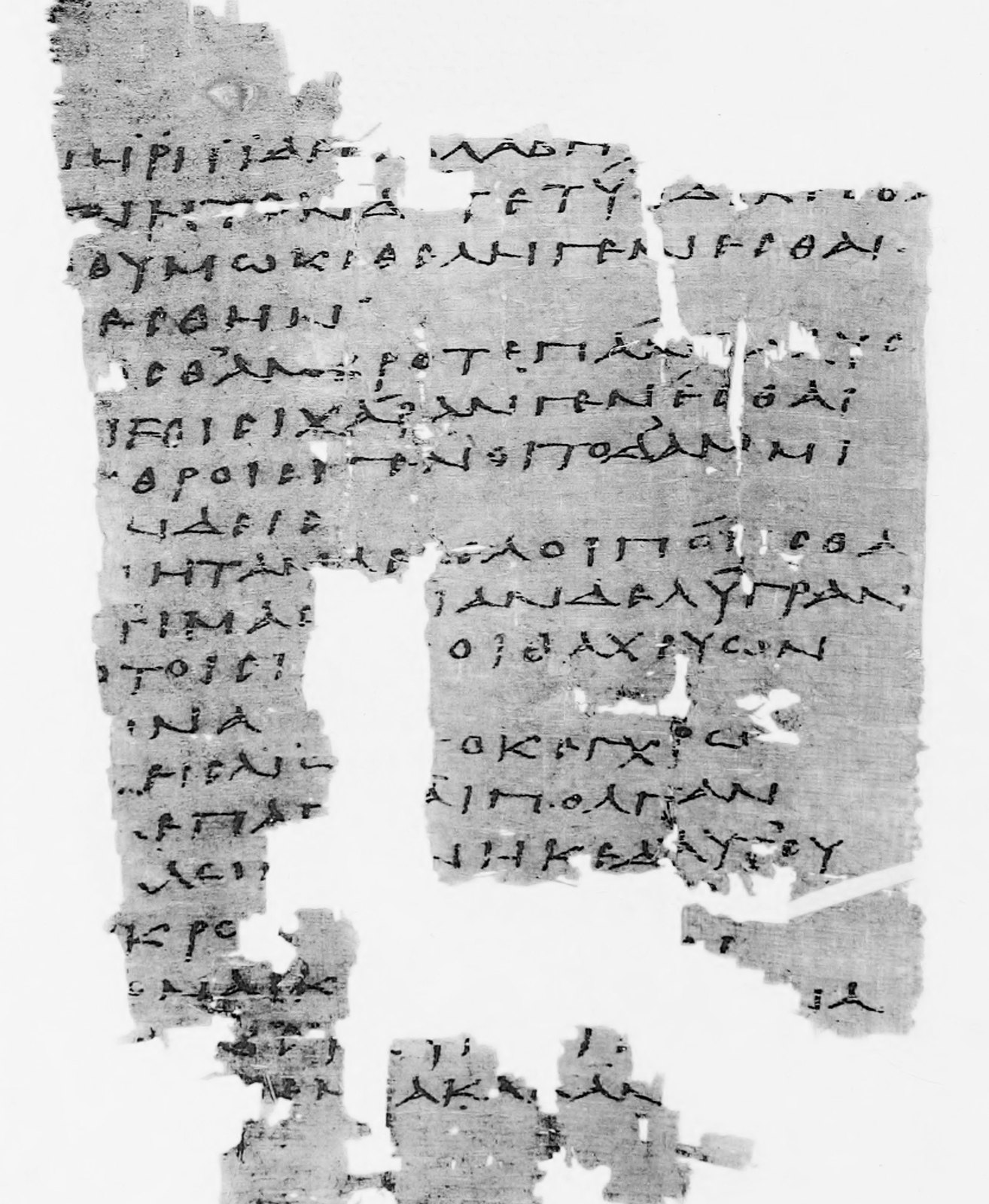
Sappho lived on the island of Lesbos, about the sixth century. She asks the goddess Aphrodite to come from Crete into a grove of apple trees. Those lines were recovered later, on a potsherd. This picture is not that poem, and it is not her hand. It is a third-century copy of another of her poems, a prayer about her brother, found at Oxyrhynchus and printed in 1898. After her, a dinner in Athens and a school of friends answer different questions.
Athens. A dinner. Diotima speaking, as Socrates tells it.
- to begin from the beauties of earth and mount upwards for the sake of that other beauty
- from one going on to two
- and from two to all fair forms
- and from fair forms to fair practices
- and from fair practices to fair notions
- until from fair notions he arrives at the notion of absolute beauty
and at last knows what the essence of beauty is.
Diotima, in Plato, Symposium
A school. Fourth century.
For without friends no one would choose to live, though he had all other goods.
Aristotle, Nicomachean Ethics 8.1, English after Ross
Sappho.To the goddess. To desire. To the absent beloved.Then a school, to friends. Not the same address.
Sources
The surviving lines are broken. Friendship, cult, desire, and address to a goddess can occupy the same fragment. Aristophanes' myth in the Symposium is comic.
- Sappho. Fragment 2, the apple grove. The opening on the page is house English. Wharton, 1885, printed only the lines ancient authors had already quoted. He did not have this opening. Public-domain method, not his sentence.
- Plato. Symposium. Diotima’s two replies, set together: “The love of generation and of birth in beauty.” “Because to the mortal creature, generation is a sort of eternity and immortality.” English after Benjamin Jowett (Oxford: Clarendon Press, 1871). Public domain. Abridged by joining the replies. Not a sentence Jowett printed as one. The ladder elsewhere on the walk is the same translation, lineated. A set of speeches, not a taxonomy.
- Aristotle. Nicomachean Ethics 8.1. English after W. D. Ross (Oxford: Clarendon Press, 1908). Public domain.
- Grenfell, Bernard P., and Arthur S. Hunt, eds. The Oxyrhynchus Papyri, vol. 1. London: Egypt Exploration Fund, 1898. Plate of P.Oxy. I 7. Sappho, fragment 5, a prayer about her brother. Third century. Public domain. Not fragment 2, the apple grove. That opening was recovered on a potsherd in the twentieth century. The English of it on this page is house English, not Henry Thornton Wharton, 1885.
