c. 1100 BCE
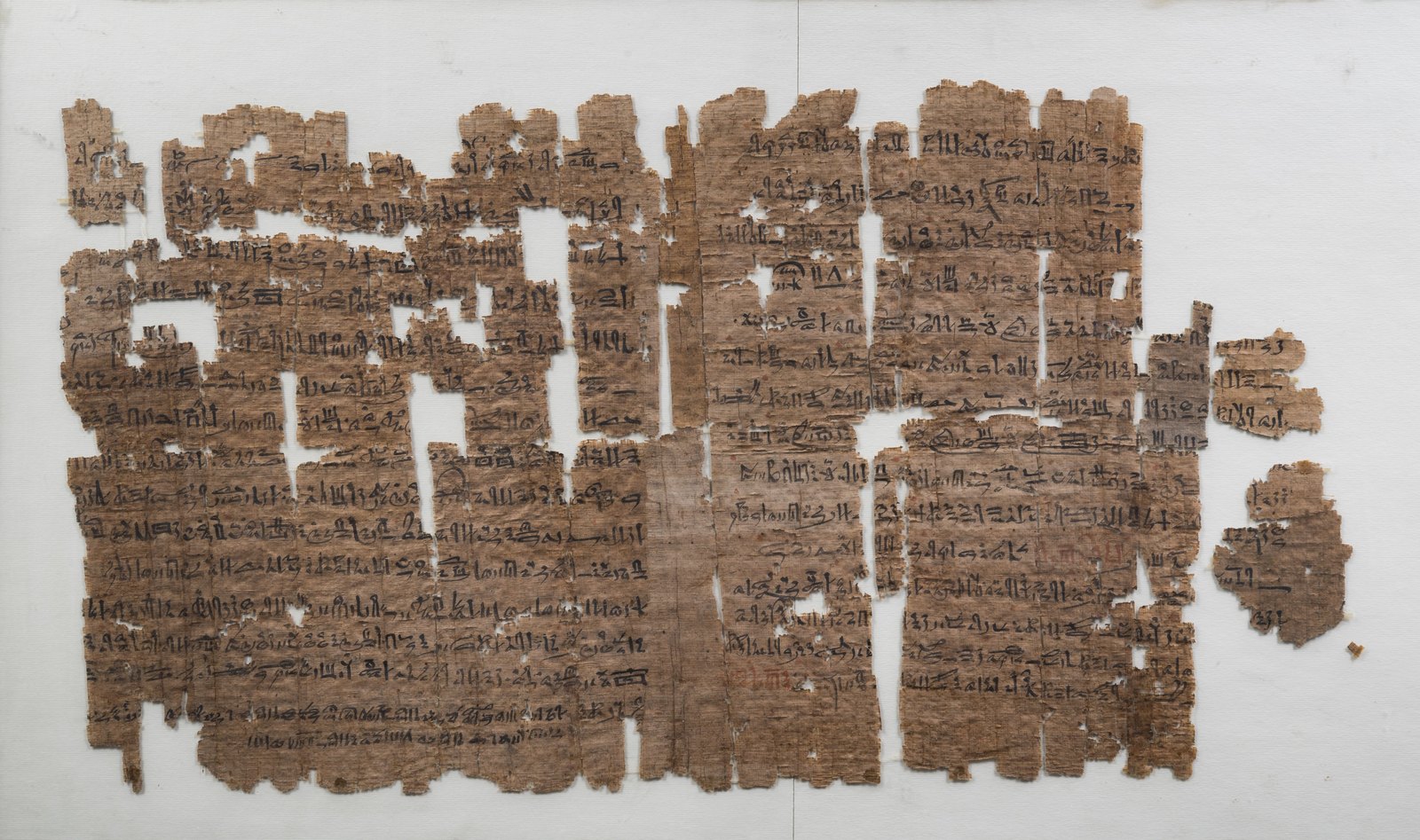
Egypt, about 1100 BCE. Across the Nile from Thebes, the tomb-workers' village. A song on papyrus. Three trees speak about a girl and her lover.
Who is speaking?
The men who lived here cut the kings' tombs in the Valley of the Kings, then came home. Someone wrote this song in the fast handwriting of that time. It was probably sung aloud. The sheet is in Turin now. The other side is accounts, not a poem. Three trees speak, one after another. The papyrus is broken at the start, so the first tree never says what kind he is. He sees the two of them under the branches, drunk, their skin rubbed with oil. He stays in fruit all year, and they still treat him as second. If they ignore him again, he will not keep their secret. The next tree was brought from far away and planted in her ground. She gave him no water. He tells her to come to him. The last is a small sycamore she planted herself. He asks them to sit in his shade today, tomorrow, and the day after. He has seen them. He will not say a word.
All that is done by the beloved and her lover I see, when they are drunk on wine and pomegranate liquor.
The first tree. English after Vincent Tobin. His name is broken off the sheet.
She caused me to be planted in her orchard, but she gave me no water.
The tree brought from far away. Same translation.
Her secret is safe with me. I shall not say a word.
The little sycamore she planted. Same translation.
One tree will tell. One is thirsty. One keeps the secret.
Three trees.To a girl.A song.
Sources
- Museo Egizio, Turin. Cat. 1966. Papyrus. Deir el-Medina (?). New Kingdom, Twentieth Dynasty, about 1190 to 1077 BCE. Recto: Songs from the Grove. Verso: administrative texts. Purchase, Bernardino Drovetti, 1824.
- Photograph of Cat. 1966. Museo Egizio. CC0 1.0. The image is the object. It is not a reconstruction of the grove.
- The lines on the page are short quotations from Vincent A. Tobin, “The Love Songs and the Song of the Harper,” in William Kelly Simpson, ed., The Literature of Ancient Egypt, 3rd ed. (New Haven: Yale University Press, 2003). Translation in copyright. The ancient text is broken at the start, so the first tree does not name himself. The Museo Egizio card calls the speakers a pomegranate, a sycamore, and a fig brought from Syria. Those names are the museum’s summary, not a line of the song.
